
IUCN RED LIST
Established in 1964, The IUCN Red List is a critical indicator of the health of the world’s biodiversity. Species are classified by the IUCN Red List into nine groups, through criteria such as rate of decline, population size and area of geographic distribution as:
- Extinct (EX) – This species is no longer extant
- Extinct in the wild (EW) – Survives only in captivity, or through cultivation often outside native range
- Critically endangered (CR) – In an extremely critical state
- Endangered (EN) – Very high risk of extinction in the wild
- Vulnerable (VU) – At high risk of unnatural (human-caused) extinction
- Near Threatened (NT) – Close to being endangered in the near future
- Least Concern (LC) – Widespread and abundant in the wild
- Data Deficient (DD) – Inadequate information to assess extinction risk
- Not Evaluated (NE) – Has not yet been assessed



The upper side of the wings is mainly white with black veins and borders. The underside is brightly coloured with striking yellow, red, orange, and black patterns, making it one of the most colourful butterflies in Asia. These vivid colours act as warning signals to predators.
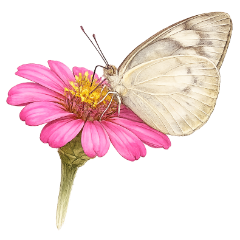
The Common Jezebel is a slow and graceful butterfly known for its gentle floating flight. It is usually seen flying high among trees but descends to flowers for feeding. Unlike many butterflies, it often remains active even during cloudy weather and is commonly observed basking in sunlight during mornings.

The Common Jezebel is generally non-migratory, though local seasonal movement may occur depending on flowering patterns and host plant availability.

Breeding occurs throughout much of the year, especially during warmer and monsoon seasons. Females lay spindle-shaped eggs in clusters on mistletoe host plants. Caterpillars feed gregariously on leaves before pupating on nearby stems or branches. Courtship involves fluttering flights and pheromone communication between adults.

Bright underside colours warn predators of unpalatability. Slow gliding flight conserves energy efficiently. Unpalatable compounds obtained from host plants help deter predators. Contrasting wing patterns improve recognition during mating.

Adult Common Jezebels feed mainly on nectar from flowering plants such as lantana, ixora, hibiscus, and jasmine. Caterpillars feed primarily on parasitic mistletoe plants growing on trees.

The Common Jezebel is commonly found in gardens, forest edges, orchards, scrublands, parks, and urban green spaces. It prefers areas with flowering plants and mistletoe host plants growing on trees. Plays an important role in pollination of flowering plants across its range.