
IUCN RED LIST
Established in 1964, The IUCN Red List is a critical indicator of the health of the world’s biodiversity. Species are classified by the IUCN Red List into nine groups, through criteria such as rate of decline, population size and area of geographic distribution as:
- Extinct (EX) – This species is no longer extant
- Extinct in the wild (EW) – Survives only in captivity, or through cultivation often outside native range
- Critically endangered (CR) – In an extremely critical state
- Endangered (EN) – Very high risk of extinction in the wild
- Vulnerable (VU) – At high risk of unnatural (human-caused) extinction
- Near Threatened (NT) – Close to being endangered in the near future
- Least Concern (LC) – Widespread and abundant in the wild
- Data Deficient (DD) – Inadequate information to assess extinction risk
- Not Evaluated (NE) – Has not yet been assessed



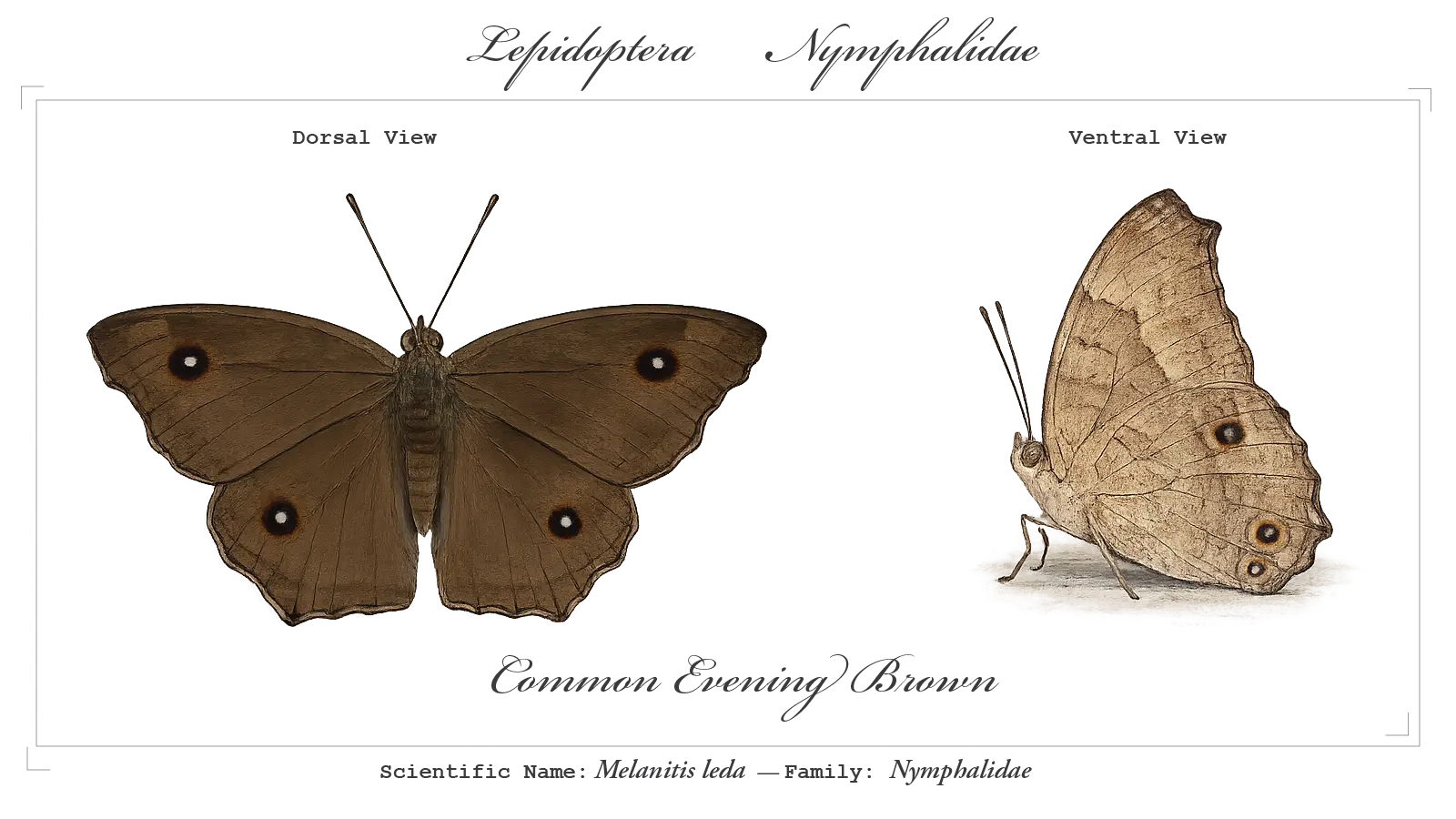
The wings are predominantly brown with intricate patterns resembling dead leaves. Distinct eyespots occur on both forewings and hindwings, particularly on the underside. Seasonal forms are common, with wet-season individuals displaying larger and more conspicuous eyespots than dry-season forms.
The Common Evening Brown is a crepuscular butterfly, being most active during dawn and dusk. During the day, it typically rests among dry leaves, grasses, or shaded vegetation where it remains well camouflaged. Its flight is rapid, erratic, and usually close to the ground.

The Common Evening Brown is primarily a resident species and does not undertake long-distance migrations. Local seasonal movements may occur in response to rainfall, vegetation growth, and habitat conditions.

Females lay eggs singly on grasses and other host plants. Breeding occurs throughout the year in tropical regions, with population peaks often coinciding with the monsoon and post-monsoon seasons when host plants are abundant.

Its leaf-like wing patterns provide exceptional camouflage when resting with closed wings. Seasonal dimorphism enables adaptation to changing environmental conditions. Prominent eyespots may help deter predators by startling them or diverting attacks away from vital body parts.

Adults primarily feed on fermenting, overripe fruits, tree sap, and decaying organic matter rather than flower nectar. Caterpillars feed on various grasses, including bamboo and members of the family Poaceae.

The Common Evening Brown occurs in forests, forest edges, bamboo thickets, scrublands, grasslands, agricultural landscapes, gardens, parks, and urban green spaces.